
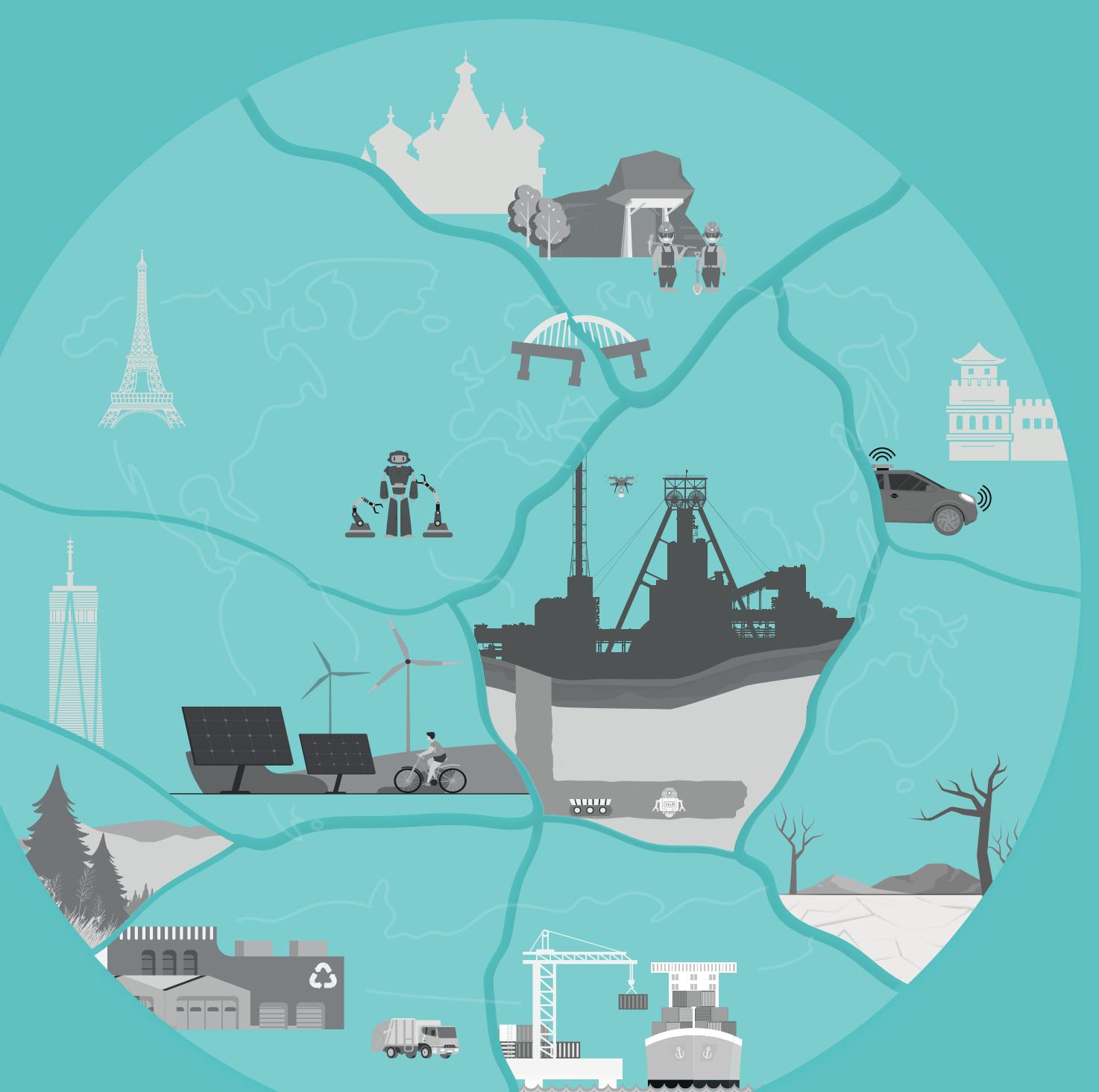
Advancement Wave
A technology boom drives progress but widens inequality
The world is divided in trade blocs, and while most developed nations reaped substantial economic growth and modernisation from the massive global push to rapidly transition energy systems during the 2030s, less-developed countries either found a track of low investment capital and technical capabilities and struggled to accelerate their development or a track of maximizing the impact of resource development into critical raw materials that were then used as leverage within and between trade blocs, creating a shadow pole of power.
Key aspects
The massive global push to rapidly transition energy systems that started in the late 2020s and continued in the following decades sparked an intense technology race reminiscent of the 1960's space race and 1990's dotcom booms. As leading economies poured funding into green innovation, breakthroughs in areas like batteries, AI, robotics, quantum computing, and fusion energy catalysed exceptional advancements. Dubbed the “Advancement Wave”, this technology boom has delivered enormous productivity gains and societal benefits to well-capitalized countries transforming transportation, energy production and distribution, manufacturing, and resilience against climate change impacts. However, intellectual property concerns and ineffective tools for technology transfer limit the impacts of these advancements in the developing world, which has exacerbated global inequality and impeded universal social advancement.
Regional trade blocs, anchored by major global players, seek to limit technology diffusion to geopolitical rivals. Knowledge hoarding and technological nationalism are strategic barriers separated along ideological lines. Some investment and technology transfers occur to lesser-developed players inside the trade blocs when it is advantageous to the major players.
These lesser-developed players, especially those with key mineral resources, leverage those resources in their relationship to their patron trade bloc. Periodically, some developing nations switch bloc loyalties while others engage with multiple blocs to reap fresh investment and political clout.
Global cooperation diminished as advanced economies turned their focus inward creating growing divergence that accentuated international inequalities and strained collaborative efforts on a global scale, particularly between blocs. Despite notable progress in mitigating CO2 emissions and the positive impacts of emerging technologies, the uneven diffusion of these advancements has deepened divides. Poorer countries face climate vulnerability and social unrest, resulting in continuous population outflow towards advanced countries and blocs thus further impeding their economic development.
International Cooperation and Domestic Policies
- Innovation within trade blocs catalyses greater integration of supply chains and collaboration between allied nations with shared priorities.
- Massive investments in domestic education, research, and localisation initiatives seek to consolidate strategic advantages.
- International forums have evolved into formations of ideological camps focused on advancing their societal/political visions rather than global-benefiting consensus. This fracturing occasionally fuels localised armed conflicts, especially in the blocs-borders regions.
- Treaties emphasize intellectual property protections, standards promotion, and joint climate resilience projects among bloc members.
- Countries outside of the bloc cores struggle by all socio-economic metrics and some have become client states of specific blocs with little autonomy or measured benefit.
Economic Situation
- Soaring consumer demand for green products, smart homes, and climate resilience services fuel intense growth in industries advancing sustainability technologies.
- Government stimuli and unprecedented private investment capital propel markets as blocs economically compete. Startups proliferate while pioneering sectors experienced labour shortages even with pan-bloc recruitment.
- Speculative investing continues into new tech firms and crypto assets tied to the Advancement Wave, resulting in bubbles. Volatile markets and cycles of exuberance among retail investors became a fixture during and after the 2030s, acting as a drag on investments in traditional industries.
- Limits on technology transfer, coupled with rapid capital shifts towards green energy, has made many developing nations suffer increased energy poverty for the lack of available infrastructure development.
Society and Environmental Aspects
- Intra-bloc focus on innovation spurs optimism on tackling pressing issues like curbing CO2 emissions and responding to climate disasters.
- Public-private partnerships around space colonisation and climate restoration moonshot projects captured imaginations as competition between blocs increases even with general shared goals.
- World leaders recognize common inter-bloc issues and embrace technology to resolve climate resilience challenges at the 2030 Sustainable Development Goals review.
- By 2040, social standards rose across all industries. Clean electrification, agricultural efficiency gains, and disaster-resilience systems brought stability for some regions.
- Limited access to novel technologies and emerging solutions exacerbate inequality between developed and developing nations.
- Researchers identified irreversible climate thresholds, tempering hopes for a full recovery of climate.
The Mining Value Chain and Mining Technologies
- Spillover technologies, like robotics and battery advances, transform mining business and practice despite persistent skills gaps.
- Electrified equipment and continuous remote operation improve productivity and safety.
- Advances in spatial data analytics accelerate identification of new deposits.
- Modular pilot plants demonstrate the feasibility of compact material processing units.
- Investors eagerly fund startups using space-derived and AI techniques for exploration, advancing deep-sea and ultra-depth mining and developing nanoscale technologies for processing and recycling operations.
- University partnerships with miners upgrade regional workforces. But demand still strains capacity, with mines struggling to keep pace with material needs for transport decarbonisation and domestic/regional climate adaptation megaprojects.
- Knowledge drain from poorer countries continues to aggravate the knowledge divide between developed and developing countries.
- Recycling is deeply integrated into the mining industry, with companies investing heavily in infrastructure and technology to capture, process, and reintegrate secondary materials into production. This reduces the industry's reliance on primary resources and creates new economic opportunities in recycling and waste management as they become raw material companies.
- Efficient resource usage is a cornerstone across the mining value chain, strengthening its ability to respond to market shifts and supply chain disruptions.
International Cooperation and Domestic Policies
International Cooperation and Trade
The era of multilateralism and extensive global exchange gave way to a divided international order. Regional trade blocs, anchored by major global players, follow their own unique values and priorities. Cooperation and trade no longer stem primarily from shared economic interests but are driven by ideological allegiances. Inside these self-contained blocs, innovation is flourishing as they compete in a relentless technology race. Enormous investments in education, research, and internal initiatives have not only solidified their strategic advantages but also fostered bloc-level self-sufficiency by reducing external dependencies. Supply chains weave the economies of bloc members into tightly integrated networks that are occasionally disturbed by individual, opportunistic “side-switchers” and source countries that remain outside of formal trade blocs and thus tend to be less stable economically and politically. The rapid pace of innovation fuels intra-bloc economic integration, enhancing efficiency and resilience. Once hubs for global consensus, international forums are arenas where ideological posturing takes centre stage. Instead of seeking global agreement, these forums have split into ideological camps, each bloc focused on advancing its own societal and political vision. Treaties have shifted their focus from promoting global trade to safeguarding intellectual property, enforcing tech and mining standards specific to each bloc, and supporting joint climate resilience and adaptation among members. Global trade remains at risk, even within blocs, as climate disruptions and periodic proxy conflicts erupt leading to new areas too dangerous to operate or transport through, and ongoing risks of malicious operator attacks on international trade routes continue, with global policing interests now driven by opportunistic powers within each bloc.
Government Regulation and Stability of Domestic Policies
Stable domestic policies and government regulations align with the energy transition and provide raw materials investors unparalleled confidence as they navigated the various stages of project development, from exploration to permitting and construction. Moreover, within trade blocs, minimal country risk premiums result in reduced capital costs for raw materials and infrastructure projects. This cost reduction has improved the return on investment for these projects and made them more appealing to equity investors.
Economic Situation
Economic Development
The fragmentation of the global market, initially perceived as a source of instability, paradoxically ignited economic growth. Countries within trade blocs recognised their mutual interdependence and embarked on collaborative initiatives, fostering a period of sustained expansion and revitalised dynamism not seen since the 1990's dotcom boom. Three key developments and trends propelled this boom:
- Technological breakthroughs in AI, robotics, quantum computing, and energy production.
- Decarbonisation efforts and cost competitive advanced energy technologies in developed countries boosting infrastructure investment.
- Rising wealth in developed regions supporting domestic investment.
However, labour shortages are a challenge, even with recruitment efforts abroad, as pioneering sectors expand rapidly. This has led to some policy conflicts within blocs, but they remain at the diplomatic level. Additionally, risky speculation emerged around new tech firms and assets associated with the Advancement Wave, leading to market bubbles and volatility. This pattern of exuberance among tech investors persisted through and beyond the 2030s. The critical limiter on growth has been the finite capital availability within each trade bloc, but in the long term has supported stronger direct reinvestment in the same economic spaces.
The inequities between developed and developing nations remain, and those countries outside of trade blocs suffer the most for lack of access to technology or capital. Selected developing nations are rapidly developing by being critical suppliers within a bloc and leverage this influence for economic and political gain.
Infrastructure
Extreme climatic events often disrupt raw materials production, processing, and transportation infrastructure, bottlenecking supply chains. For this reason, competitive dynamics in mining has shifted towards near-market projects or to well-connected locales. Nevertheless, discoveries in untapped regions drive substantial government investments in infrastructure including roads, rail, and ports linking raw materials production areas to export hubs. Remote and overseas sources that require marine-based transport are weak links in the mining chain due to their exposure to raids and conflicts because of their unprotected duration in international waters. Additional investments in power production and distribution, water supply, and telecom connectivity to increase climate resilience improve local development and spur broader infrastructure expansion.
Price Volatility
Soaring consumer demand for sustainable products and climate resilience services, driven by government incentives and private investments, gives pricing power for producers of raw materials used in these technologies. Labour shortages, risky speculation in tech firms and assets, market bubbles, and formal and informal global conflicts introduce short-term price volatility that sporadically affects the raw materials sector. Additionally, disruptions by extreme climatic events, and competition for resources in certain regions, create supply chain bottlenecks, leading to sporadic price spikes for specific raw materials.
Profit
Companies and investors expanding production of critical raw materials now enjoy substantial returns, driven by:
- Growing and sustained demand for raw materials crucial for clean energy technologies.
- Robotic technology adoption, enhancing precision and efficiency in small, high-grade deposit extraction.
- Supportive jurisdictions streamlining permitting and investing in infrastructure.
Society and Environmental Aspects
Social Attitude towards Mining, Public Acceptance
In the early 2030s, optimism pervaded global society fuelled by breakthrough innovations to address urgent challenges like CO2 emissions and climate impacts. Public-private partnerships centred around ambitious space colonisation and climate restoration initiatives captured the collective imagination. World leaders embraced technology to tackle climate resilience issues during the 2030 Sustainable Development Goals review. By 2040, social standards had improved across various industries. Access to clean, low cost, reliable power, agricultural efficiency gains, and robust disaster-resilience systems have increased stability in many regions. Raw materials production is perceived as a necessity to achieve energy transition objectives and safeguard the strategic autonomy of countries and the stability of blocs. Mining has gained some level of social tolerance and acceptance as a vital industry. Nevertheless, some mining projects compete with local communities for essential resources like water, causing localised public opposition to mining.
Mining Workforce
As the demand for raw materials surged, labour costs within the mining industry soared. The heightened competition for skilled workers among numerous projects has intensified the race for existing talent. Raw materials producers use strategic workforce management practices to optimise production while contending with the limitations of a limited pool of experienced personnel. This has catalysed the adoption of automation and robotics within the raw materials sector as companies seek innovative solutions to augment their labour force and enhance operational efficiency. Despite the diversification of the mining industry and inclusion of local communities in their operational decisions, automatization and robotisation has decreased aggregate employment in the populated mining regions for less-skilled labour, especially in developing countries, which is further exacerbating the difference in living standards within blocs.
Responsible Consumption and Production
The major trading blocs prioritise self-sufficiency and innovation making sustainability practices, such as efficient resource use, waste reduction, and environmentally friendly production, essential for long-term resilience. Responsible consumption and production standards and practices, fostered by industries and public-private partnerships, are common amid technological advances and decarbonisation efforts.
Integrated Climate Action
In the early 2030s, technological innovations enabled the reduction of CO2 emissions and response to escalating climate impacts. By 2040, regions that embraced clean electrification and robust disaster-resilience systems experienced newfound stability. The raw materials industry, driven by policy incentives to accelerate the energy transition, scaled up the production of essential metals for electric vehicle batteries and renewable energy technologies. A transformative shift occurred in the mining industry, as major miners transitioned from extractors to raw material providers to actively promoting circular economy models by capturing value through the entire cycle. These “material providers” now forge close bonds with the communities surrounding their mines, fostering economic and social inclusion and dedicating revenues to climate resilience projects. This progressive approach supports public acceptance of the sector and accelerates innovations around mining areas, including enhanced CO2 storage, primary hydrogen production, and alternative process chemistries to mitigate emissions.
Even as these positive changes unfold, a stark divide persists globally. Lacking access to novel technologies and emerging solutions, less developed countries within each trade bloc struggle to keep pace with their more advanced counterparts. Additionally, disquieting research on irreversible climate thresholds casts a shadow of uncertainty over hopes for the future and identifies increased risks for countries without access to the advanced technologies to support climate impact mitigation.
Water and Energy Strategies
Breakthrough technologies like nuclear fusion and water recycling enables unlimited and affordable water and energy resources, driving mining expansion into previously constrained regions and benefiting remote areas globally. The raw materials producers embrace sustainability, on-site renewable power generation, and reducing energy-intensive processes. However, recurrent extreme climatic events strain raw materials production. While stockpiling is effective in curbing the negative effects of disruptions for speciality metals, major commodities such as iron, copper, zinc, and aluminium are profoundly affected, resulting in occasional supply chain disruptions and price fluctuations.
Environmental Impact of Mining
While transforming into raw materials providers, miners are investing heavily in electrifying operations, deploying renewable power, and adopting zero-emission vehicles, all aimed at reducing their carbon footprint. Stricter regulations, tax incentives for green investments, and societal pressures drive this shift. In several remarkable cases, these “materials providers” became stewards of vast natural areas surrounding mining sites, guarding biodiversity, and striving to reduce CO2 emissions. The mining industry, once seen as a polluter, is now viewed as a positive force for sustainability, equitably providing raw materials vital for clean energy while achieving ambitious decarbonisation goals. However, given economic constraints, small miners operating in developing countries struggle to obtain financing or technical expertise to implement similar upgrades. Governance and regulatory oversight remain weaker in those countries, enabling lagging polluters to continue operating. Simultaneously, global mining companies face growing expectations to ensure consistent best practices across all operations, including in developing countries.
Collaboration to close mining's pollution gap between rich and developing nations within trade blocs has grown in efforts to level the competitive playing field and promote broad sustainability. These actions are underpinned by the common, top-level goals of the major trade blocs in addressing global issues their own way but has helped keep nominal influence of international organizations as places of dialogue.
The Mining Value Chain and Mining Technologies
Market Demand for Raw Materials
The rising demand for raw materials, driven by the energy transition and the expansion of digital and energy infrastructure to support AI, quantum computing and advanced manufacturing needs, spurred mining companies to adopt strategic measures. These included expanding operations, reopening dormant mines, and adopting circular economy models to enhance production capacity.
Mineral and metal prices have surged, boosting revenues and enabling mining firms to invest in innovative technologies and community development. Research and development efforts focus on enhancing recovery rates from low-grade ores and extracting small deposits and unconventional resources, such as deep-sea, brine, deep, and urban mining. Exploration activities have also gained momentum as junior mining companies partnered with tech firms and utilised AI to discover new mineral deposits. In response to this dynamic landscape, mergers, acquisitions, and joint ventures are commonplace in the raw materials sector. These strategic actions aim for economies of scale and greater regional diversification, ensuring resilience against market fluctuations. However, challenges persist, including skill shortages, rising production costs, and community tensions, occasionally necessitating government intervention to facilitate agreements.
Full Supply Chain Tracking and Traceability of Mined Materials
Effective implementation of supply chain tracking systems to mitigate local negative environmental and human rights abuses, improve business planning, and simplify reporting for tariff systems are commonplace. This was possible due to three factors:
- Clear guidance on reporting requirements to certify minerals as "responsibly produced" or to enforce existing and future regulations related to the production and sourcing of minerals.
- Effective enforcement of existing regulations related to environmental, labour, and human rights.
- Increased consumer awareness.
Due to higher overall long-term benefits, mining communities embraced responsible resourcing and valued it above shortterm direct financial benefits, leading towards a narrowing of the inequalities within blocs.
Industry Structure and Value Chain Structure
Efficiency and financial objectives drove raw materials producers to outsource non-essential functions instead of handling them in-house. This has led to specialisation and outsourcing of non-core tasks becoming the standard in the sector. Raw materials producers frequently collaborate with various contractors for exploration, extraction/recycling, processing, and reclamation activities, often forming partnerships with Original Equipment Manufacturers. By delegating non-core activities to specialised contractors, raw materials producers now focus on:
- Managing ore deposits.
- Ensuring financial performance.
- Monitoring environmental performance.
- Building community relations.
Raw Material R&D
Developed countries are shifting toward a circular materials economy, reducing the need for primary extraction. Successful R&D applied to the raw materials sector efforts led to:
- Materials science advances enabling substitutes for rare earth elements in magnets, batteries, and electronics.
- Emphasis on urban mining, extracting metals from electronics, batteries, and vehicle waste streams, serving as a significant supplementary source of CRMs.
- Improved recycling processes, making recovery of metals highly profitable within a circular supply chain.
- Utilisation of chemical leaching, bioleaching, and nanotechnology to enhance extraction from low-grade ores and mining wastes, expanding recoverable resources.
- Advancements in tailings and landfill mining, advanced sorting, and processing of landfill deposits, reclaiming metals discarded decades ago when recycling was uneconomical.
Despite these advances, the demand for primary raw materials remains robust, driven by ongoing economic development and the energy transition.
Share of Mining in Extreme Conditions
As onshore deposits are depleted, raw materials producers turn to remote and challenging regions like African and Asian deserts, the polar regions, and deep-sea areas in the Pacific and Arctic Oceans. Technologies such as automation, robotics, AI, and remote operation make extraction feasible in these extreme environments.
Stringent environmental regulations and guidance mitigate negative mining impacts in extreme and previously pristine environments. The existing international frameworks for resolving territorial disputes have faced challenges, leading to proxy (mainly diplomatic) conflicts among major powers over access to mineral-rich regions and playing on the allegiance of less developed countries to a given bloc across continents.
Exploration
Intelligent tools have greatly boosted mining exploration productivity, relying on:
- AI algorithms and machine learning systems to analyse vast geological datasets, identifying patterns that minimised uncertainties and enhanced the likelihood of discovering mineral deposits.
- Autonomous drones and drill rigs for quicker and safer surveys and sampling in remote or hazardous areas.
- Advanced spectroscopy, 3D imaging, and sensor technology for faster sampling and geological feature analysis.
- Data from various sources consolidated into dynamic 3D models of subsurface mineral structures, accurately pinpointing drill locations.
- Real-time data during drilling for fine-tuning exploratory operations through predictive analytics, maximising the chances of hitting mineral deposits.
Increasing automation in exploration has significantly reduced costs and shortened exploration cycles, resulting in more discoveries.
Extraction and Processing Technologies
The mining industry's widespread adoption of automation and data-driven techniques increased returns. This is supported by:
- A significant boost in productivity and cost reduction across mining operations, driven by autonomous and robotic equipment, and AI-powered control systems.
- Implementation of dynamically adjusted production strategies using data analytics and digital twins, encompassing models of mineral deposits, extraction, logistics, and equipment maintenance.
- Substantial reduction in downtime through continuous operations and a sharp decline in accidents.
- Selective and optimised extraction methods targeting zero waste, resulting in higher recovery rates and economically viable extraction of low-grade ores and small deposits.
- Enhanced capacity to adjust output in response to demand, reducing price volatility.
However, the industry now faces stiff competition for digitally talented workers from other sectors.
Winners and Losers
Winners
Industry
- Tech and green innovation companies.
- Investors in sustainability assets.
- High-skilled workers specialised in emerging technologies.
- Raw materials producers supplying minerals needed for the energy transition.
Regions, Organizations, and others
- Developed countries at forefront of sustainability technologies.
- Major trading power blocs.
- Countries/regions with good geological endowments.
- Regions were mines/raw materials production centres were installed/reopened.
Losers
Industry
- Blocs reliant on external raw materials supply chains.
- Fossil fuel sector companies and hydrocarbonproducing countries.
- Workers displaced due to automation.
- Mining companies lacking advanced capabilities.
Regions, Organizations, and others
- Poorer and developing countries lacking access to innovations.
- International organizations that are simply played by the competing blocs for political gain.
Protagonists
- Major powers; leading regional trade blocs.
- Charismatic leaders of the energy transition and tech-advancement.
- Innovators/academics of breakthrough technologies (nuclear fusion, robotics, AI).
- Regions/countries with rare/unique minerals/metals.
Disruptions
Geopolitical
- Resurgence of multilateral cooperation and emphasis on global cooperation amid shared threats like pandemics, conflicts, or climate change.
- Reconciliation or leadership change causes reconfiguration of major blocs (e.g. U.S.-North Korea rapprochement).
- Severe tensions or conflicts between technological rivals within major blocs disrupt R&D spending and productivity.
- Armed conflict(s) beyond regional limits or directly between major players.
Economic
- Speculative bubble bursts or extended recessions within major blocs undermine investment capital needed for ongoing innovation.
- Commodity price spikes or critical raw material supply constraints spur reconsideration of open trade policies.
- Winner-take-all dynamics concentrate gains too narrowly; popular backlash leads to policy reversals.
Social
- Concerns over inequality and instability prompt demands for better wealth distribution systems.
- Governance reforms increase oversight and accountability for technology impacts.
- Migration flows disturb the self-sufficiency of blocs.
- Civil unrests in resource-rich, yet poorer regions.
Environmental
Environmental:
- Much faster climate change impacts timeline demands urgent global cooperation.
- Critical threats in spheres like oceans, rainforests, or methane emissions override bloc differences.