
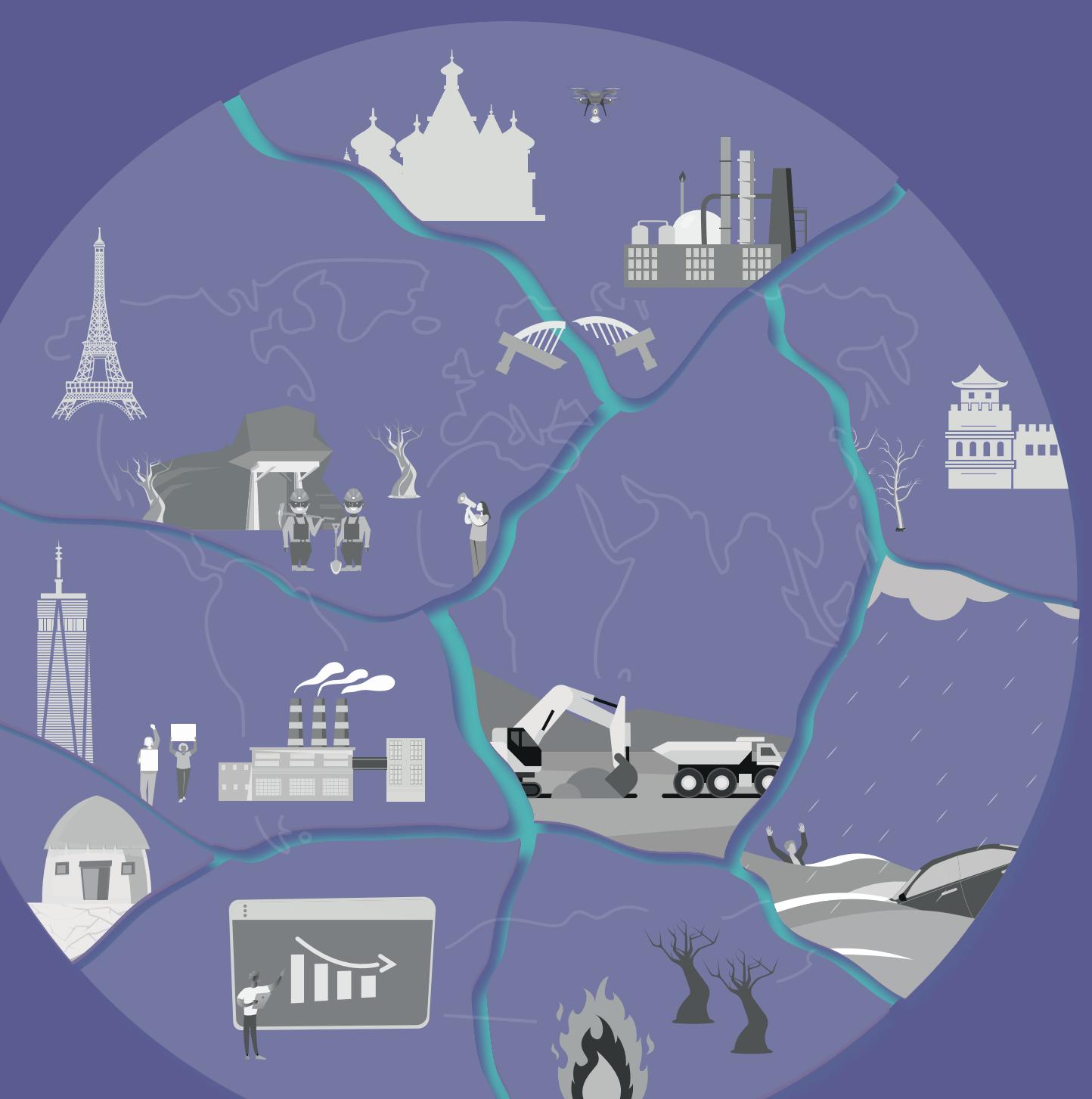
Divided Dominions
Self-contained blocs imperil economic growth and development
Amidst escalating geopolitical rivalries, the emergence of self-contained trade blocs with conflicting worldviews post-2030 results in substantial market distortion, imperilling research, innovation, and the energy transition, yielding only modest, long-term economic growth and fostering social unrest in developed and developing countries.
Key aspects
Persistent grievances over influence, power, and wealth distribution drove deglobalization leading to the establishment of self-contained trade blocs built on distinct approaches to global issues and economic and social governance with virtually no cross-bloc investment, trade or technological cooperation. This new system is predominantly shaped by dominant major powers and their interests, aimed at bolstering the competitiveness of critical industries such as AI, space, defence, communications, electronics, and health. Other nations face mounting pressure to align exclusively with on bloc. Recognized that domestic raw materials endowments could not sustain downstream manufacturing needs, major countries worked with other like-minded countries for raw material access for domestic industries. In response, excluded nations formed alliances and obstructed the export of critical raw materials to “elite blocs.” Regional conflicts and proxy wars became commonplace, fuelled by historical animosities. Fragile peace is consistently under threat of conflicts where alliances are not sacred, and opportunism and “realpolitik” prevail.
The geopolitical schisms volatilized critical raw materials markets, undermining long-term development. While there were opportunities for limited technological improvements and efficiency gains, a weakened extraction and recycling industry failed to realize robust investments and growth, leading to economy-wide impacts of an inefficient raw materials supply chain.
International Cooperation and Domestic Policies
- Trade blocs are based on factors such as former military alliances, ideological alignment, and language. Fierce competition among blocs has fragmented markets with limited trade between blocs.
- The fragmentation severely hampers global cooperation across issues of sustainable development, climate action, humanitarian aid, migration, public health, and poverty reduction. The United Nations (UN) and other bodies struggle to broker even modest accords among distrustful blocs. Official development assistance is often tied coercively to the strategic interests of patron states. Dissent within blocs is met with threats of expulsion or isolation.
- Supply chains are vulnerable to disruptions as the small number of suppliers and potential buyers operating within each trade bloc is a limited buffer against demand and supply shocks.
- Developing nation bloc members with unique resources leverage their position to play bloc leaders off each other, switching bloc alignments when advantageous.
Economic Situation
- The fragmentation has ruptured integrated supply chains and demand dynamics across sectors, resulting in severe commodity price volatilities, market uncertainties, and speculation-fuelled hoarding within blocs. Stranded assets and redundant capacities cause misallocation across infrastructure.
- Growth prospects drastically diverged between blocs as zero-sum mentalities supersede cooperative advancement. Despite rising green technology demand, scaling constraints persist from chronic underinvestment, skills gaps, and bottlenecked logistics.
- Uneven, intra-bloc development has deepened societal rifts whenever governance was captured by entrenched blocs favouring militarisation and industrial subsidies to select interest groups, while other socio-economic issues are sidelined.
- Capital is captive within blocs, and with low economic growth, capital returns are low thus limiting reinvestment opportunities.
Society and Environmental Aspects
- The cascade of economic and political disruptions drives waves of mass migration, civil unrest, and ideological extremism, overwhelming fragile governments. Hollowed-out public sectors are unable to deliver essential services leading to expansion of shadow networks and militant factions.
- Severely weakened international organizations are unable to provide any real influence on addressing of global concerns, such as climate change impacts.
- Excluded communities face soaring inequality and climate vulnerability with minimal state or international support. Perpetual uncertainty and precarity fuel sectarian tensions and regression of social progress.
- Geopolitical instability has derailed climate commitments, with bloc leaders deprioritizing threats that required cooperative action. Environmental oversight capacity has declined amidst deregulation drives to spur industrial self-sufficiency. With the demand for critical raw materials rising, irresponsible extraction practices expand, especially where civic activism is suppressed.
- Volatile commodity prices strain responsible miners trying to balance profitability with duty of care.
- Some progressive national governments and regions are trying to lead by example but face difficulties mobilising partners across business, civil society, and science to support systemic change.
The Mining Value Chain and Mining Technologies
- The accelerating mines-to-market rivalries prompt major powers to invoke defence priorities across minerals supply chains thus redirecting outputs towards domestic manufacturers. Smaller bloc players face squeezed access, forcing higher cost substitutions. Upstream specialisation has increased within blocs but stifled overall optimisation.
- Heavy state interference skews commercial drivers. Investment flowed into large-scale projects, but lagging state-owned conglomerates in developing countries focus on import replacement rather than innovation to bring step-change solutions.
- Responsible mining struggles as price volatility and policy unpredictability hamper compliance budgets.
- Diverging standards across competing blocs create interoperability challenges, slowing the diffusion of breakthrough innovations like automation and AI analytics. First-mover blocs restrict sensitive technology transfers and poached talent.
- While recycling and substitution progress continue, increasing opportunity costs from severed R&D linkages delay technology diffusion.
- Small enclaves within major blocs discreetly collaborate across borders, laying the groundwork to propel circular value chains.
International Cooperation and Domestic Policies
International Cooperation and Trade
Rising nationalist sentiment and major power rivalries have driven dominant countries to abandon cooperative global systems and construct restrictive trading blocs centred on boosting domestic industries. These major bloc powers utilise protectionist tools like discriminatory standards, punitive tariffs and bans on certain imports/exports to severely limit trade and collaboration between rival blocs.
Smaller mineral-producing nations are coerced through diplomatic and economic pressure to participating in one of the rival trading blocs. Their allegiances frequently shift based on who provides better patronage rather than shared values and mutual interests. The fracturing of integrated global supply chains into isolated trifurcated networks enable internal bloc flow of goods and capital at the expense of overall market stability, efficiency, and innovation potential.
Stability of Domestic Policies
The dominant bloc powers maintain stable priorities to bolster their global position. Cooperation on transnational issues like climate change, pandemics, and inequality are severely hampered by zero-sum mentalities and a narrow focus on mitigating impacts on the bloc. While regime changes occur, successor governments adopt status quo policies due to pressures from entrenched militaristic and corporatist factions who benefit most from the status quo of continued geopolitical tensions.
Reform attempts are thwarted as political leaders use nationalism and external threats to channel public frustration away from underlying domestic governance failures. Civic dissent and demands for accountability face crackdowns justified as pre-empting foreign subversion. The divide is a self-fulfilling cycle bereft of collective leadership on shared planetary challenges.
Major powers have sacrificed global cooperation and ethics at the altar of parochial interests tied to dominating rivals — forcing smaller nations into arrangements that erode universal progress. Reversing this fragmentation requires inclusive civic movements centred on pluralism, transparency, and prosperity.
Economic Situation
Infrastructure
The fragmentation into trade bloc markets has increased risks and uncertainty through reduced diversity of capital, reducing return on investments in mining projects and associated infrastructure. Many miners postpone upgrades and maintenance which is leading to accelerated deterioration of roads, bridges, rail lines, etc., which are all vital for operations. Over time, subpar infrastructure networks are imposing hard limits on reliable mineral extraction and export volumes globally. Logistical bottlenecks and supply chain inefficiencies are commonplace with most mining companies struggling to navigate regional transport links.
Price Volatility
Frequent commodity boom and bust cycles within trade blocs make mining projects increasingly risky as price forecasting models are challenging and capital markets less diverse. The concentrated markets mean that a few key players can create exaggerated ripple effects. While some miners sporadically benefit from cycles, the volatility generally hampers rational expansion plans thus slowing productivity growth. Buyers also swing between delaying purchases or hoarding based on extreme price swings.
Commodities largely sourced from lesser-developed nations are particularly positioned to influence pricing within a given bloc. By leveraging their unique role in supporting economic activities, they shift allegiance to blocs with the best offer, creating additional pricing volatility within a bloc but not necessarily globally.
Economic Development
The loss of positive external impacts from mining growth and global integration inhibits broader economic development. Global GDP continues to limp around 2-3% annually, mainly driven by trade within individual blocs rather than globally. Furthermore, the inclination towards economic nationalism and growing distrust, even within trading partnerships, hampers cross-border investments crucial for balancing the impacts of dwindling private sector infrastructure financing. Supply disruptions and declining productivity instigate prolonged economic stagnation, posing particularly severe challenges for developing countries.
Society and Environmental Aspects
Responsible Consumption and Production
High market volatility and geopolitical rifts foster tendencies towards short-term commercial interests over responsible production despite initial drivers to bolster supply chain nationalisation and sustainability-advancing industries domestically. With demand still rising for critical raw materials, most miners satisfy minimal standards rather than proactively promoting the adoption of best practices for sustainable mining and processing. Lagging adoption is most severe where public/democratic oversight is suppressed and an authoritarian government exists. Nevertheless, progressive governments and civic movements focus on transparency, equity, and ethics spearheading innovation partnerships between like-minded states and responsible businesses.
Environmental Impact of Mining
Environmental impact trajectories diverge between developed and developing country miners - the former progressively adopting emission controls, water preservation etc., due to market pressures and rising public climate concerns; the latter still struggling from financial constraints and governance gaps preventing uptake of expensive sustainability upgrades - except responsible global (or bloc-wide) miners that uniformly adopted best practices irrespective of operating geography. However, the overall net impact increases irresponsible extraction given demand increases, downstream pressure to reduce input costs, and weak enforcement capacities from disjointed global agreements and prioritization on bloc growth.
Social Attitude towards Mining, Public Acceptance
Initial acceptance of mining's importance for self-sufficiency has given way to growing public scepticism and pockets of resistance, fuelled by lagging transparency, captured local benefits, and recurring environmental incidents that strain community trust. Repeated ownership changes, uneven local hiring and weak environmental rehabilitation commitments also erode public trust. Risks of social unrest are high, particularly where income inequality, vulnerability gaps, and civic voice deficits grow with economic instability and authoritarian policies that mute equitable advancement.
Mining Workforce
Self-contained trade blocs severely impact labour flow, which is driving acute shortages, especially in productivity-increasing skilled roles like processing, equipment maintenance, analytics, etc. Attempts to compensate through automation negatively impacts community support due to a reduction in visible hiring. Attracting talent necessitates drastic measures like exempting miners from military conscription alongside rising wages thus straining small operators. Targeted reskilling programs were curtailed and impeded by insularity priorities. Skills shortages remain a bottleneck driven by a lack of cooperation to align training, labour mobility, and incentives to meet demand.
Integrated Climate Action
High market uncertainty discourages most miners from significantly investing to meet the Paris Agreement's climate ambitions. Momentum loss was partially substituted where national governments instituted rigorous emissions caps, set bold demand signals, and enabled risk-sharing schemes that guaranteed adequate returns. But discordance across fragmented policy spaces neutralised the impact of such pockets of progress. Without cooperative incentives and commercial drivers aligned with climate policy signals, most companies hesitate on actions beyond operational efficiency or adjusting to local regulations.
The Mining Value Chain and Mining Technologies
Market Demand for Raw Materials
Under worsening recessions and continued market uncertainty, critical raw materials demand languishes. Prices plunge forcing affected miners to scale back high-cost operations and slash expenditures on exploration, new projects, and expansions, and only retain the lowest-cost mines. A prolonged downturn bankrupted miners lacking financial depth, further concentrating supply. Without cooperation to align demand signals and smooth the technology adoption curve for mineral-intensive applications, these conditions are entrenched amidst weak investment.
Industry Structure and Value Chain Structure
The pursuit of efficiencies drives outsourcing of non-core mining competencies to contractors and Original Equipment Manufacturers. Undercapitalized miners trade equity to secure offtake agreements and risk-sharing with major manufacturers across sectors like defence, automotive and electronics – generating stable demand amidst volatile markets. Reliance on downstream players has increased despite earlier ambitions of achieving self-sufficiency across all raw material supply chain stages. Collaborative specialisation helps adequately capitalised miners enhance productivity.
Raw Material R&D
High mineral price volatility drives investment in R&D for recycling and substitution to bypass exaggerated trade bloc supply-demand imbalances and lower primary production dependence. However, progress remains confined to developed country blocs with financing capacities, stable policy incentives for commercialisation, and sustainability-conscious consumer demand. Computing, automation, and material breakthroughs are dramatically improving the viability of urban mining, battery chemical reclamation, etc., but diffusion barriers limited global gains.
Extraction Technologies
The adoption of automation, data analytics and interconnected industrial hardware across mining operations have boosted productivity, real-time supply-demand modulation, and predictive maintenance to insulate against external volatility. Critical advances include autonomous haul vehicles, AI for exploration and mining operations and drone surveying, enabling continuous operation. However, even with lower employment intensities, the technologies alone haven't resolved acute labour and skills shortages, and miners have increased recruiting budgets to lure digitally adept talent away from other sectors.
Winners and Losers
Winners
Industry
- Low-cost mineral producers are more resilient to market fluctuations. These producers have deposits that are cheaper to exploit and/or can reduce production costs through technology R&D and increased efficiency.
- Mineral producers that enjoy a competitive advantage solely based on their geographical location.
- State-owned miners, aligned with governing regimes for patronage and growth.
- Tech companies.
- Highly skilled workers specialized in emerging technologies.
- Speculators, profiting from high commodity price volatility.
Regions, Organizations, and others
- Dominant bloc powers able to push partisan interests using economic and military power.
- Most developed economies.
- A small proportion of developing countries with rich resources and near-shoring opportunities to support their bloc's lead powers.
- Countries with good geological endowments and existing infrastructure.
Losers
Industry
- High-cost producers in blocs with an oversupply of minerals.
- Small miners in developing countries that lack resources to adopt best practices.
- Mining innovators struggling from dampened investment and unstable policies.
- Mining companies lacking advanced capabilities.
- OEMs and consumers in trade blocs facing supply shortages.
Regions, Organizations, and others
- Future generations.
- A large proportion of developing countries.
- Multilateral institutions, unable to broker. meaningful accords across hostile blocs/Global institutions like UN, G20, WTO, ICC.
- Citizens in totalitarian regimes face repression and stifled dissent and liberties.
- Global tourism.
Protagonists
- Major power blocs' leaders aggressively pushing partisan agendas.
- State-backed miners, aligned with governing regimes for patronage.
- Developing nations with unique resources of global demand.
- Speculators and middlemen exploiting volatility for profits.
- Multilateralists aiming to heal rifts by aligning incentives.
- Activist citizens pressuring blocs on sustainability and rights failures.
- Academics/developers of breakthrough technologies.
- Intra-bloc financial institutions (banks from developed countries within specific bloc).
Disruptions
Geopolitical
- Progressive political leadership capable of messaging shared interests over wedge issues.
- Violent conflicts spurring on peace movements.
- Growing resource nationalism (even a trade bloc can be seen as too much trade).
Economic
- Discoveries enabling abundant, low-cost clean energy could remove scarcity-driven resource conflicts.
- Younger generations prizing sustainability and cooperation, could drive policy shifts when in power.
Social
Public health emergencies creating openings for scientific collaboration across borders.
Environmental
Catastrophic extreme weather events could force cooperation to build climate resilience amidst common threats.