
Future Mining Scenarios
A forward-looking exploration of the mining industry's future, set against the backdrop of the year 2050

Preface
A stark reality confronts the global economy: the accelerating shift towards advanced manufacturing, digitalisation, and clean energy technologies is driving an unprecedented demand for raw materials and metals. This shift toward a minerals-intensive future, coupled with technological breakthroughs and social transformations, collides with cascading global challenges, making tomorrow's landscape increasingly difficult to forecast, let alone predict. The adoption and deployment of advanced technologies follows a non-linear path, shaped by broader economic conditions, political and regulatory forces, and societal dynamics. Organisations and governments, striving to prepare for what lies ahead, must navigate this complexity with limited resources while traditional power structures evolve, and new global influences emerge. Western economies, in particular, face mounting pressure to diversify and secure critical mineral supply chains — a challenge exacerbated by the mining industry's long lead times and numerous uncertainties surrounding market conditions, operating environments and societal conditions. This kaleidoscope of change requires a nuanced understanding of potential futures.
This factbook presents a forward-looking exploration of the mining industry's future to the year 2050. Our approach combines rigorous analysis with innovative foresight methodologies. We utilised an explorative scenario technique akin to a Delphi process, drawing upon insights from a broad spectrum of experts who contributed their understanding of the forces shaping the mining industry. Their diverse backgrounds enabled us to examine the complex interplay of geopolitical contexts, societal dynamics, technological advances, and environmental challenges, particularly in the realm of extreme climatic events and artificial intelligence (AI) applications.
The analysis yielded nine distinct scenarios, from which we have distilled the four most representative and instructive. These scenarios integrate externalities spanning political, economic, societal, technological, environmental, and legal spheres. They acknowledge the increasingly visible effects of climate change, demographic pressures, health crises and growing economic inequality. While these pressures, combined with rising misinformation and declining institutional trust, create new stress points, we also recognise the potential solutions offered by AI, scientific innovation, and the reimagining of traditional international cooperation frameworks.
We understand that tomorrow's reality is unlikely to align perfectly with any single one of these four scenarios. Instead, the future will likely emerge as a complex weave, incorporating elements from each pathway we describe. These scenarios serve as strategic lenses through which policy-makers and industry leaders can view potential futures and prepare for the ways in which interconnected trends will reshape economies, societal structures, and raw materials supply-webs. They also illuminate the critical inflection points and choices that can steer the world towards one future over the other.
Our ultimate aim is to inspire mining and raw materials organisations to evolve beyond traditional operating models and provide them with tools to navigate future challenges with confidence and purpose.
Key take-aways for policymakers and industry leaders
The importance of understanding potential mining futures for policy-making
Globally, the mining sector is foundational to a sustained economic development, providing the essential raw materials that form the building blocks for a range of transformative industries such as robotics, digital infrastructure, AI, and clean energy. For resource-rich countries, it also serves as a crucial driver of economic development. However, the industry is grappling with unprecedented challenges, including intensifying geopolitical tensions, opaque and manipulated markets, mounting environmental concerns, and increasingly complex social license to operate issues.
These scenario analyses serve as a strategic tool rather than a predictive exercise. Their primary purpose is to stretch thinking and enable future-proofed strategies in two critical ways:
- Supporting policy-makers in designing resilient policies that can withstand various potential futures,
- Illustrating how policy decisions today can influence which scenario materialises, recognising that the future remains malleable and will likely combine elements from several scenarios.
The analyses emphasise that geopolitics and policy choices, both domestic and international, will fundamentally shape the future trajectory of raw materials supply. The actions of policy-makers, companies, investors, and communities will collectively determine which elements of these scenarios become reality.
The scenarios and their implications
The analysis presents four distinct scenarios for the future of raw materials supply:

The Advancement Wave
A technology boom drives substantial productivity gains and societal benefits in well-capitalised countries, transforming transportation, energy systems, and manufacturing whilst boosting climate resilience. Trade blocs work to restrict technology diffusion to rivals to maintain their competitive edge, while uneven access to technology and capital within blocs exacerbates inequality between developed and developing nations.

Divided Dominions
Fragmented trade blocs distort minerals and metals markets, imperil economic development and weaken both extraction and recycling industries. Limited international cooperation hampers innovation and sustainable development, while diverging standards create inefficiencies.
Downward Spiral
Resource nationalism breeds global and domestic instability, leading to economic volatility and environmental degradation. International cooperation collapses as countries pursue self-sufficiency, resulting in inefficient duplication of efforts and increased conflicts.

The Great Transition
A global catastrophe serves as a catalyst for unprecedented international cooperation, leading to a transformed society focused on sustainability and shared prosperity. This scenario features strong multilateral coordination, harmonised standards, and accelerated technological innovation serving collective interests.
Strategic imperatives and path forward
The concentration of critical mineral supply chains in a single country creates legitimate national and economic security concerns about supply disruptions and geopolitical risks. Since the recent pandemic exposed supply chain vulnerabilities, countries started responding with varying approaches.
The United States deployed a range of policy tools — from Defence Production Act authorisations to funding programmes under the Bipartisan Infrastructure Law and Inflation Reduction Act — aimed at incentivising domestic capacity building and promoting supply from more secure sources. Financing tools through the Export-Import Bank and Development Finance Corporation were directed towards overseas critical minerals projects that strengthen supply chain security and create commercial opportunities for U.S. industry, while closer collaboration with allies focused on developing strategies to collectively address anti-competitive behaviour in global markets. Finally, the United States have been more proactive in using trade tools to protect their domestic industries. In contrast, the European Union takes a multi-pronged approach through its Critical Raw Materials Act, building on three pillars:
- The first pillar strengthens domestic capabilities by targeting 10% extraction, 40% processing, and 15% recycling of annual EU consumption by 2030. It accelerates strategic project permitting while advancing research and innovation.
- The second pillar creates partnerships with aligned resource-rich nations through joint ventures, technology transfer, EU development funding, and dedicated cooperation platforms.
- The third pillar enhances supply security via EU-wide risk monitoring, strategic stockpiling, joint procurement, supply chain certification, and trade defence mechanisms. This integrated approach aims to secure 25% of EU critical materials needs through reliable partnerships by 2030.
Both approaches emphasize domestic capacity, international partnerships, and market protection, though the EU framework provides more specific targets and structured mechanisms.
Global developments — including US and EU policies to date — suggest a movement towards the Divided Dominions and Advancement Wave scenarios. While concerning signs of trade tensions and bloc formation emerge, examples of successful international cooperation persist. The status quo in 2024 shows a worrying tilt towards fragmentation, with policies not yet optimised for sustainable, responsible mining to support global development. Yet our trajectory towards 2050 remains far from certain — all futures, including Downward Spiral and Great Transition, remain possible. Recent EU and US elections are poised to reshape the political landscape, potentially bringing substantial shifts in policies impacting the mining sector. Similar political transitions worldwide could further reshape how nations approach domestic critical minerals development and international cooperation. Understanding what drives different outcomes is therefore crucial.
Five factors emerge as fundamental differentiators between the four scenarios for the mining sector's future: First is the extent of technological innovation adoption across the mining value chain. Breakthrough technologies, including spill-over advances from other industries, can transform mining operations by improving productivity, reducing operational costs, enhancing supply chain transparency, minimising environmental impact, and helping address persistent workforce challenges through automation and digital solutions. Second is improving societal acceptance of mining operations through meaningful community engagement, equitable benefit sharing, and demonstrated environmental stewardship. Third is the establishment of stable, predictable policy frameworks that provide the certainty needed for long-term investment and strategic planning. Fourth is managing demand volatility through mechanisms such as long-term contracts, public procurement policies, and market-making instruments that provide greater certainty for investors, producers and consumers alike. Fifth is the degree of international cooperation versus zero-sum competition. While some policy-makers may lean towards protectionist strategies and domestic-first policies, the most successful paths forward strengthen national capabilities while also maintaining some level of international cooperation.
To move towards the more positive outcome, policy-makers must take several decisive actions:
- Maintaining strong public support for mining and materials processing R&D through grants, loans, and research hubs remains crucial. This support should prioritise innovation and commercialisation of technologies that reduce costs, improve efficiency, and mitigate environmental impacts while fostering cross-sectoral collaboration. The success of initiatives such as the US-EU-allied collaboration on technology development, including partnerships with Japan and South Korea, demonstrates the potential of international cooperation.
- Improve societal acceptance of mining through two complementary approaches. Building on recent efforts under the CRMA and the 2023 debt ceiling bill in the United States, the permitting process needs reforms focused on clarity of rules, objectivity of decision-making, and efficiency of execution — improvements that can not only streamline permitting but also help build trust in the process itself. Second, governments must clearly define relevant stakeholders and establish frameworks for meaningful engagement in the permitting process to ensure that affected communities see visible benefits from resource development.
- Create mechanisms to minimise cyclicity and de-risk investments in critical minerals projects. This requires both, supporting the deployment of mineral-intensive energy technologies and digital infrastructure, while simultaneously creating policy incentives for downstream manufacturers to diversify supply sources. For critical raw material producers, market certainty can be strengthened through mechanisms such as offtake agreements, long-term contracts, and metal-backed exchange-traded funds. Complementing these efforts, public procurement policies can shape demand patterns while promoting recycling and circular economy initiatives that create additional stability in materials markets.
- Enhance multilateral cooperation. Existing fora offer valuable platforms for technological and socio-economic progress. The G7 can develop sustainable standards and enhance industry transparency, while the Mineral Security Partnership and various bilateral and multilateral working groups can support high-standard mining projects that diversify global supply chains. These efforts require strengthened dialogue between public and private sectors, pooled funding mechanisms, and state guarantees to de-risk strategic projects. Bilateral and multilateral trade agreements can further facilitate the flow of responsibly produced minerals and metals.
- Move beyond short-term electoral cycles to focus on long-term strategic planning. Success requires sustained political commitment and policy stability across electoral cycles, along with getting the balance right - between domestic security and international cooperation, between environmental protection and economic development, between local impacts and global benefits - to avoid the pitfalls of the «Downward Spiral» and «Divided Dominions» scenarios, while capturing the opportunities presented by technological advancement and international collaboration.
Methodology
This publication provides a forecast for the future of the mining industry in 2050. The experts that developed these future scenarios followed a structured approach, employing the scenario technique. This method provides insights into an unpredictable future based on well-elaborated factors and dynamics that shape our world. The scenario technique combines knowledge from sectoral experts with sophisticated strategic foresight methods leveraging economic, political, technological, environmental and social trends and responses.
The approach underlying the scenarios presented in this booklet comprises 5 major steps (Fig. 1). It begins with the identification and clustering of relevant influence factors, followed by a cross-impact analysis. The process culminates in the development of narratives that are based on projections of the identified influence factors. Scenario Procedure
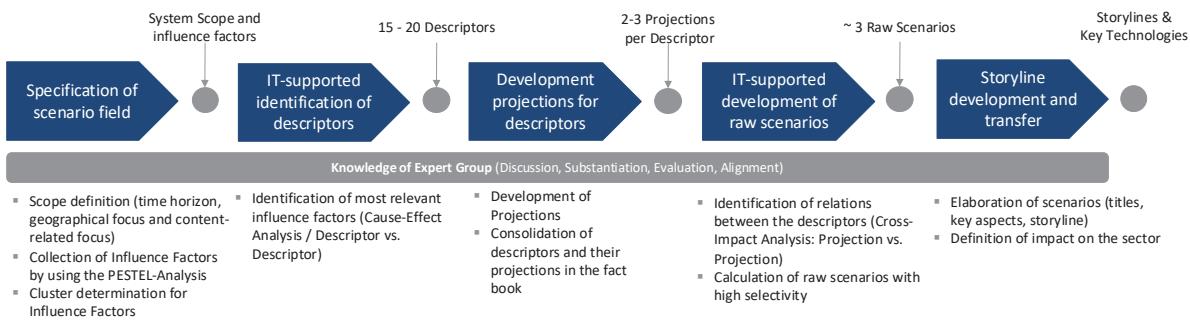
Figure 1: Scenario procedure flowchart.
The joint team from the United States and Europe combined their expertise using the PESTEL framework to comprehensively analyse the future environment of the mining sector. During two workshops held online and physically in April 2023 in Brussels, they identified 20 main factors driving the mining industry in 2050. The system grid presented below (Fig. 2) summarises these main factors, with their relevance to future scenarios, decreasing from the top right to the bottom left of the illustration.
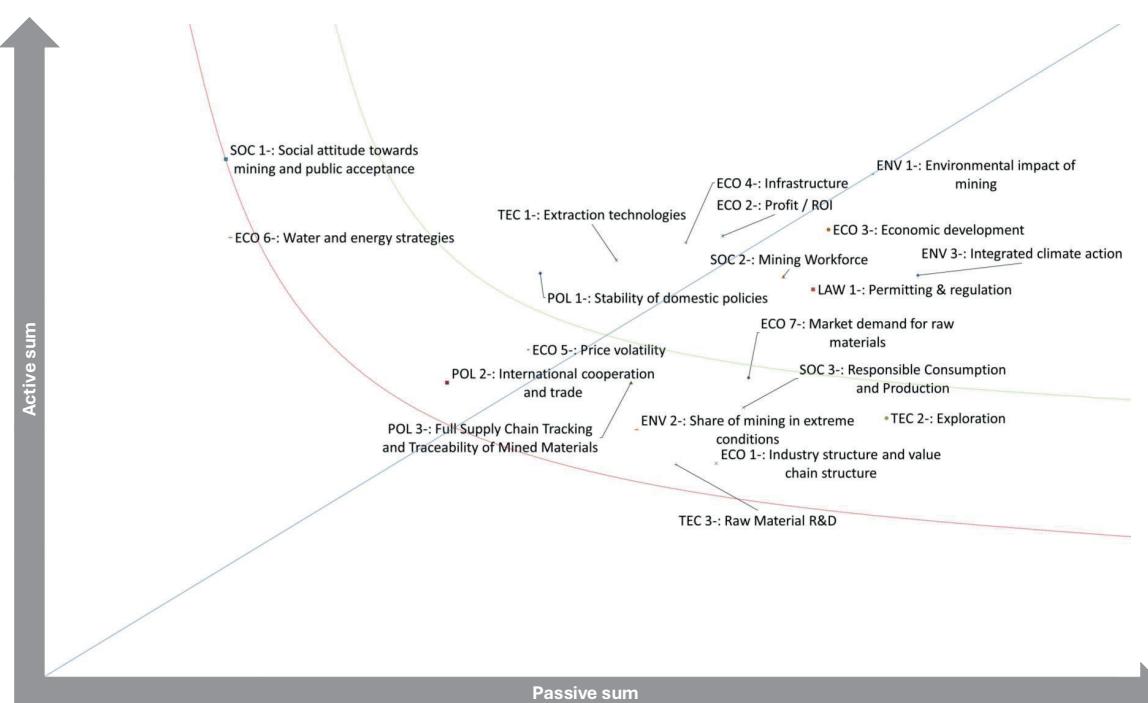
Figure 2: Relevance of main factors for the future scenarios (system grid).
Following this step, robust projections for these influence factors were iteratively developed, consolidated in a fact book and matched through a cross-impact analysis. The analysis included comparison of all projections in pairs to address the viability of their co-existence in the future. For each influence factor, experts developed between two and four meaningful projections, describing the elaboration of the different influence factors in 2050. A software-based matching of the different projections using the Cross-Impact Balances method (CIB) and the ScenarioWizard Tool of the CIB-Lab (University of Stuttgart) ultimately yielded nine scenarios. Subsequently experts clustered these nine scenarios into four raw scenario clusters (Fig. 3).
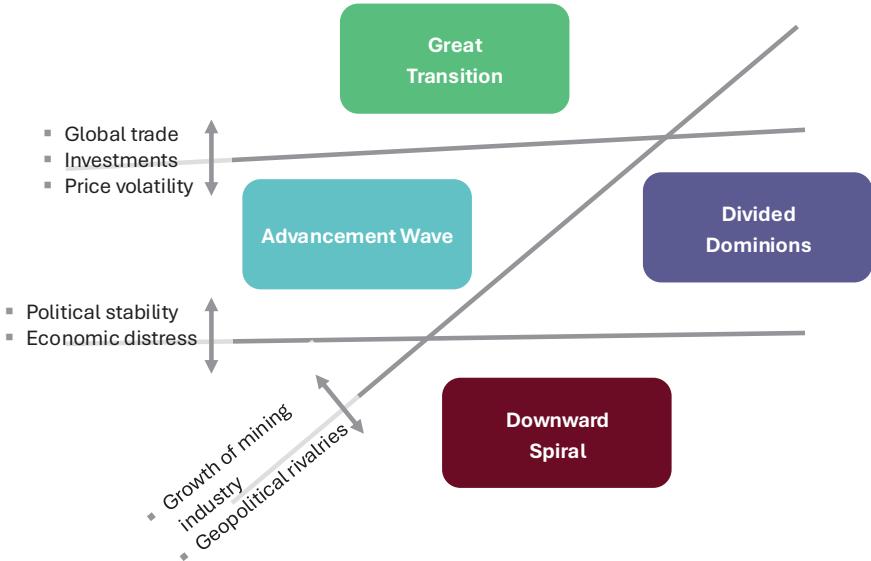
Figure 3: Final four raw scenario clusters developed.
By early 2024, each scenario cluster evolved into a fact-based elaborated narrative. The core team of experts from the United States and Europe developed these narratives iteratively through a series of workshops. Each storyline follows the same systematic structure. Starting with an explanation of the global political climate aligned with the future economic situation, the societal and environmental situation in 2050 is outlined. For each of the four narratives, the future in the mining value chain and the technological progress of the mining industry are projected based on these overarching developments. Winners, losers and main protagonists provide insight into the balance of power between stakeholders in the raw materials sector, including governments at all levels, industrial sectors, civil society, and global organizations. Finally, potential disruptions that might impact the determined transition are identified.
The World of Raw Materials in 2050
Explore the details of each scenario by clicking its card below.
Acknowledgements
This factbook stands as a testament to the collective effort and commitment of many people involved in advancing knowledge in the field of geopolitics of resources. The authors would like to acknowledge the following individuals for their significant contributions [listed alphabetically]:
Albéric Mongrenier, Anna Chiara Vigna, Anna Stancher, Carol Pettit, Dina Carrilho, Dirk Fincke, Eberhard Falck, Elise Feron, Fabiana di Lorenzo, Flavius Sturm, Giorgia Stasi, Glen Burridge, Helena Robert i Campos, Kaare Nielsen, Kennedy Rashid, Laia d'Armengol, Luis Lopes, Maciek Jastrzebiec-Pyszynski, Maureen Gallagher, Melvinne Nanjala Renju, Nelson Cristo, Pierpaolo Proni, and Quentin Deforge. The authors would also like to extend their gratitude to the many respondents to surveys related to this work who chose to remain anonymous.
Authors
Vitor Correia, Christopher Keane, Marko Komac / INTRAW Zubeyde Oysul, Abby Wulf / SAFE Danielle Woodring / Burns & McDonnell Engineering Co. (formerly SAFE) Stephan Schuele / IAO Fraunhofer
Graphical design
Anita Stein / INTRAW
DOI: 10.5281/zenodo.13238689 © INTRAW & SAFE, Brussels, 2024

intraw.eu/2050-scenarios

© INTRAW & SAFE, Brussels, 2024